
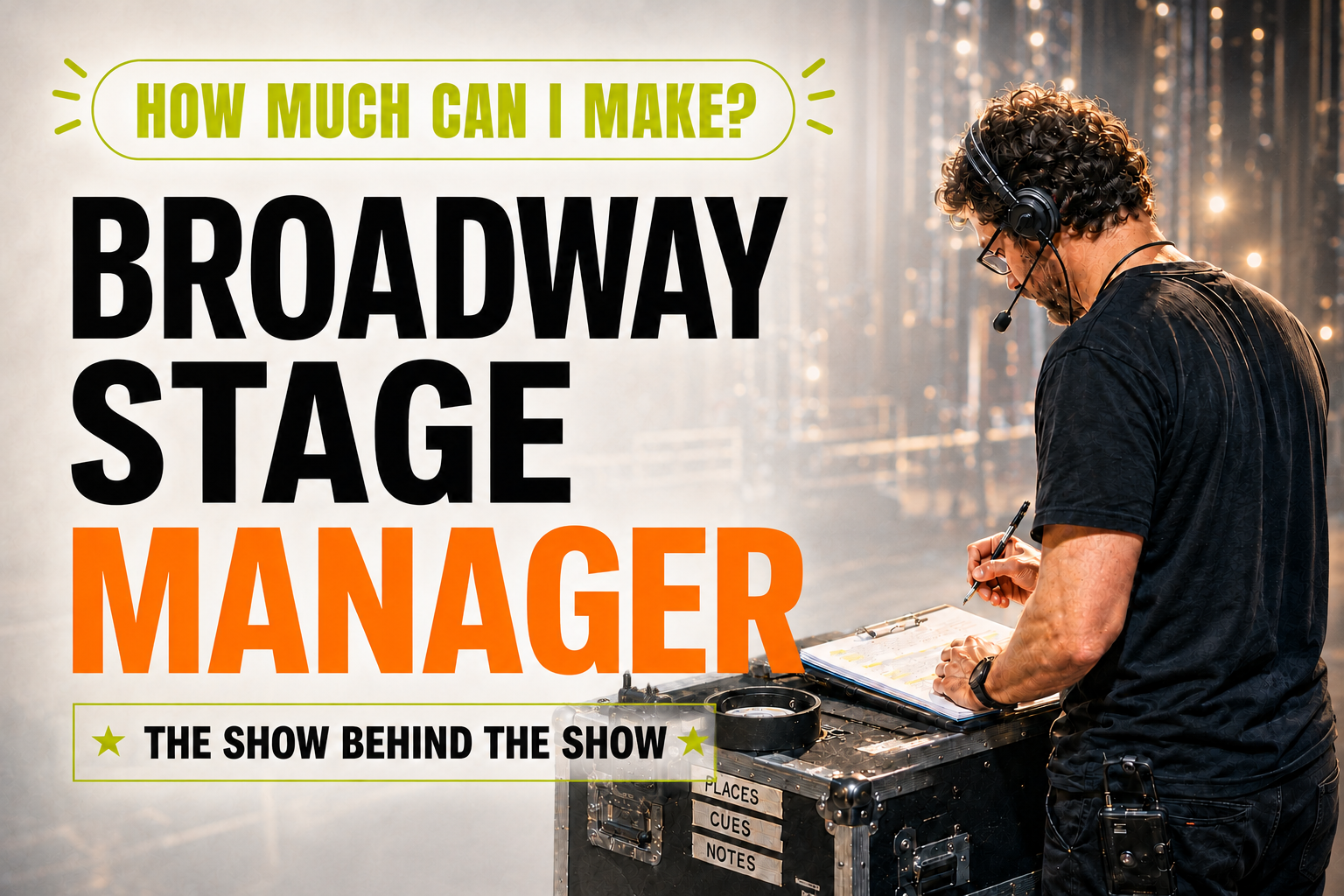
A 30-Year Broadway Veteran Pulls Back the Curtain on Stage Management
$30K → $200K+
Go behind the curtain with Billy, a Broadway stage manager — from his first $292-a-week gig to calling cues on Tony Award-winning productions like Hello, Dolly!, Master Class, and Take Me Out.
What you’ll learn in this episode:
- How to break into stage management with zero experience
- What a stage manager actually does before, during, and after a show
- The demands and challenges of the job
- How much you can earn on
- What it’s like to work with celebrities
- How to handle a medical emergency in the audience mid-performance

How Much Can a Stage Manager Earn?
This is the person running the show — literally. Pay varies enormously depending on where you work.
- Entry-level / off-Broadway: $292–$1,000/week
- Regional & mid-tier: $1,000–$2,500/week
- Broadway (union minimum): $4,000/week
A production stage manager on a long-running Broadway hit like Hamilton or Wicked can pull in $200K+ a year, plus pension contributions, health insurance, and 401(k) funding from the producer.
What Does a Stage Manager Actually Do?
Quick answer – What Does a Stage Manager Do?- A stage manager runs every aspect of a production: scheduling rehearsals, coordinating designers and performers, calling all lighting and sound cues live during performances, managing understudies, and handling anything that goes wrong — including injuries onstage and medical emergencies in the audience.
The shorter answer, as Billy puts it, is: what doesn’t a stage manager do? From the first rehearsal to the final curtain call, the stage manager is the operational center of the entire production.
- Pre-rehearsal: Contact designers, schedule fittings, prepare floor plans and prop lists, send welcome communications to cast weeks before rehearsals begin
- Rehearsals: Keep everyone on schedule, coordinate three simultaneous rooms for a musical (book scenes, music, choreography), call breaks, write daily reports
- Tech week: Move from the rehearsal studio to the stage and integrate the full crew — lighting, sound, sets, costumes — into a unified show
- Performances: Call every lighting and sound cue in real time, watch the stage like a hawk, manage understudies, and handle anything unexpected.
How Do You Become a Stage Manager?
Quick answer – How to get started — high school drama, college theater, or community theater. Volunteer to build sets, run props, or assist on crew. There’s no substitute for being in the room as a production comes together. Most working stage managers started as performers or crew members first.
- Join your high school or college drama department — do everything, not just performing
- Volunteer at a community or regional theater; offer to assist on any production
- Learn every department: lighting, sound, carpentry, costumes, props
- Build relationships — stage management is largely a word-of-mouth profession
- Work toward joining the union (IATSE or Equity) for long-term career stability
You may also like:
Behind the curtains – Theatre Director →
Another Great Theatre Career – Wig & Makeup Artist →
FAQ
How much does a Broadway stage manager make?
The union minimum for a production stage manager on Broadway is $4,000 per week. On a long-running hit show, total annual compensation — including pension and benefits — can exceed $200,000.
What is the difference between a stage manager and a production stage manager?
The production stage manager (PSM) is the lead — they oversee the entire show and run all performances. Assistant stage managers (ASMs) support the PSM during rehearsals and backstage during the run. On large productions, a team of two to four stage managers works together.
Do you need a degree to become a stage manager?
No degree is required, but theater training — formal or informal — is essential. University theater programs are valuable because they require performers to work backstage too, giving future stage managers a full picture of how productions are built.
Is stage management a stable career?
It’s fully freelance — you move from union contract to contract, with gaps in between. Many stage managers supplement their income early in their careers. Joining the union and building a strong professional reputation are the keys to long-term stability.
What skills does a stage manager need?
Organization, calm under pressure, and the ability to collaborate with large, ego-driven creative teams. Billy is direct about it: you have to check your own ego entirely. Your job is to support every other artist in the room.
Do stage managers go on Broadway tours?
Yes — and touring can be lucrative. You know your contract length upfront (often 18 months or more), and per diem on the road can supplement your weekly pay significantly, especially if you manage expenses well.