
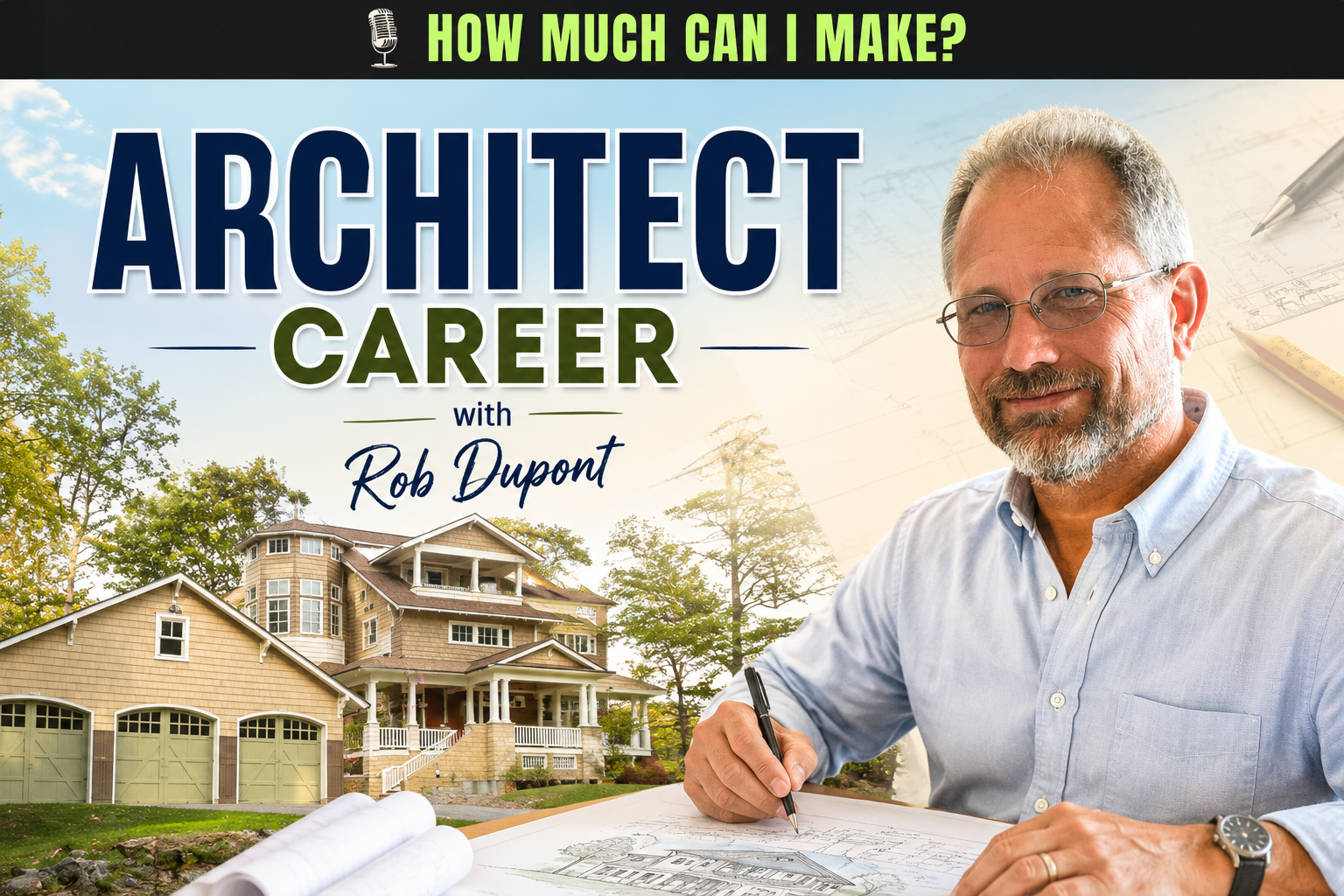
Architect Career: Real Pay, Licensing & Building From Blueprint to Completion
Starting around $25/hour → Six Figures+
In this episode, we go behind the scenes with veteran architect Robert Dupont, a sole proprietor based in New York’s Hudson Valley who has spent nearly four decades designing new homes, additions, and renovations. He explains what it actually takes to become a licensed architect, how much the job pays at every stage of a career, and how AI, energy codes, and shifting client tastes are reshaping the profession.
What you’ll learn in this episode:
- What education and training you need to become an architect
- How architect licensing works
- What architects actually do beyond designing buildings
- Why networking is so important for getting architecture jobs and clients
- How much beginning architects can make
- Why owning your own architecture firm can significantly increase earning potential
- What a typical building project looks like from concept through construction
- Why architects may work 50–60 hours a week
- How AI is beginning to affect architecture
- How building codes, budgets, sustainability, and clients influence design

How much can you earn?
Architect pay is tiered by license status, experience, and business structure. Employees earn a steady salary; firm partners and independent owners have the highest ceiling, but it takes years of networking and referrals to get there.
Architecture student / intern: ~$20/hour
Newly licensed architect: ~$25/hour (roughly $50K–$55K/year); higher in NYC, Boston, and LA — lower in Texas and other lower cost-of-living markets
Staff architect (several years’ experience): $60K–$90K
Associate / project architect: $90K–$130K
Firm partner / principal: $150K–$200K+
Sole proprietor (own firm): Highly variable — tied directly to volume of work and referral network; can exceed $200K, but building a firm “is not a sprint, it’s a marathon”
Licensing costs: ~$200–$300 to renew a state license every 3 years, plus a reciprocity fee to add licenses in additional states
What type of architecture can you specialize in?
Architecture offers many different directions.
Rob works as more of a general practitioner, taking on new construction, additions, renovations, modern projects, and traditional buildings. Other architects and firms specialize in areas such as:
- Residential architecture
- Commercial architecture
- Hospitals
- Schools
- Sports facilities
- Building-envelope restoration
- Skyscrapers
- Renovation and historic buildings
Rob explains that specialization can make firms more efficient and profitable because they develop deep expertise in a specific type of project.
You may also like:
Check out more Creative Careers →
FAQ
How much do architects make?
Interns and students typically earn around $20 an hour. Newly licensed architects earn roughly $25 an hour, or about $50,000–$55,000 a year, with pay running higher in expensive metros like New York and Boston and lower in cheaper markets like Texas. Staff architects with several years of experience earn $60,000–$90,000, associates and project architects earn $90,000–$130,000, and firm partners or principals often earn $150,000–$200,000 or more. Sole proprietors who own their firm have the highest earning ceiling, but income is tied directly to the volume and reputation of their business.
How long does it take to become a licensed architect?
It typically takes 5 years to earn a professional architecture degree, followed by a multi-year apprenticeship working under licensed architects at a firm. Only after that apprenticeship can a candidate sit for a state licensing exam — a multi-day series of tests that must be passed to practice as a licensed architect. All told, most architects spend close to a decade between starting school and becoming fully licensed.
What does an architect actually do all day?
An architect spends far more time on construction drawings than on creative sketching. A typical project starts with a client meeting to define the scope, followed by measuring existing conditions, producing a sketch concept, and revising it based on client feedback. The bulk of the job is then producing detailed construction documents that show contractors exactly how to build to code, coordinating with structural engineers and builders, and working with the local building department to confirm the plans meet zoning and energy codes.
Is AI replacing architects?
Not yet, and most architects don’t see it that way. AI tools are already helping clients generate rough renderings of what they want, which can speed up the design process — similar to how CAD software replaced hand drafting without eliminating the profession. AI can help with tasks like sizing structural beams, but it still can’t replace the judgment required to turn a client’s needs, a budget, and a building code into a finished, buildable design.
Do architects need an engineering degree?
No. Architecture programs include supplementary coursework in structural and mechanical systems so architects understand how buildings go together, but a separate engineering degree isn’t required. Architects typically work alongside licensed structural engineers, who are brought on as consultants for the technical calculations on a project.
How do architects find clients and get work?
Overwhelmingly through networking and referrals, not advertising. Architects who do good work and build strong relationships with builders, engineers, and past clients get repeat referrals over time. Many independent architects start by subcontracting drafting work for other firms before building enough of a reputation to generate their own client base.
This show first aired on August 2026