Civil Engineering Job

Salary, Stability & Building the Infrastructure We Depend On
$85K – $200K+
Turns out, designing bridges takes way more than just drawing a few lines—it’s a mix of math, logic, creativity, and a whole lot of responsibility. Anthony drops some solid career insight into what it takes to break into the field, what the work is really like, and why bridge design is one seriously in-demand gig. If you like the idea of building something that actually gets people places—safely—this could be the career path for you. Tune in and see if the bridge world is calling your name
What you'll learn in this episode:
• What a bridge designer actually does day to day
• Why nearly every bridge has a planned lifespan
• How bridges are designed to withstand decades of use
• Why bridge engineering is one of the most stable careers available
• What skills and education are needed to enter the profession
• How much bridge designers and civil engineers can earn
• Why there is a growing demand for infrastructure professionals
• The famous bridges that inspire engineers around the world
How much can you earn?
Bridge designer salaries vary by experience, location, and responsibility level.
Entry-level bridge designer: $70,000–$90,000
Mid-career bridge engineer: $90,000–$150,000
Senior bridge engineer / technical lead: $150,000–$200,000+
Project manager: $180,000–$250,000+
Engineering firm owner: Potentially much higher depending on projects and staff size
Bridge engineering is part of the broader civil engineering profession, which tends to offer strong job security due to ongoing infrastructure maintenance, rehabilitation, and replacement projects.
What does a bridge designer actually do?
A bridge designer develops the plans, calculations, specifications, and construction documents needed to build or rehabilitate bridges. Most of the work happens long before construction begins. Bridge designers use engineering software, structural analysis tools, 3D models, and detailed calculations to determine how a bridge will carry traffic, withstand weather, resist earthquakes, and remain safe for decades.
Projects can involve:
• Designing entirely new bridges
• Replacing aging structures
• Widening existing bridges
• Repairing damaged infrastructure
• Inspecting bridges and recommending upgrades
• Coordinating with contractors and transportation agencies
While some bridges become famous landmarks, most bridge engineers spend their careers working on smaller local bridges that help people travel safely every day.
Why is bridge engineering such a stable career?
Unlike many industries, infrastructure never stops aging. Many bridges currently in service were built during the 1950s, 1960s, and 1970s. As these structures reach the end of their design life, governments must repair, rehabilitate, or replace them. Even during economic downturns, roads, bridges, tunnels, and public infrastructure still require maintenance and investment. That ongoing need makes civil engineering one of the more recession-resistant career paths.
Who should consider becoming a bridge designer?
This career may be a good fit if you:
• Enjoy math and physics
• Like solving complex problems
• Want to build things that have a lasting impact
• Appreciate practical, real-world work
• Prefer long-term stability over chasing trends
• Enjoy engineering, construction, and infrastructure
Bridge designers often describe the profession as a combination of technical problem-solving and public service.
Education and training
Most bridge designers begin by earning a degree in civil engineering. Common pathway:
• Bachelor's degree in Civil Engineering
• Master's degree (often preferred for bridge design roles)
• Engineering internship or co-op experience
• Professional Engineer (PE) license after gaining experience
Many engineers specialize further in structural or transportation engineering.
You may also like
System Engineer for NASA Project →
Want a New Career? Reinvention →
FAQ
How much do bridge designers make in the US?
U.S. civil engineers specializing in bridge design typically earn $85,000–$130,000 per year, with senior engineers and project managers earning more. Salaries vary by state and employer — federal and state DOT positions offer stability, while private consulting firms often pay more at senior levels.
Do you need a master's degree to become a bridge designer?
In most cases, yes. A master's degree in civil engineering is typically required. A Professional Engineer (PE) license is also expected for those signing off on designs, which requires work experience and a licensing exam on top of the degree.
How long does it take to become a bridge designer?
Plan on six to seven years minimum: four years for a bachelor's in civil or structural engineering, plus a two-year master's program. Licensure as a PE typically requires an additional four years of work experience after graduation.
Is bridge design a stable career?
Very! Infrastructure demand doesn't disappear in recessions — if anything, government stimulus spending often accelerates it. The backlog of aging bridges in North America means demand for bridge engineers is expected to stay strong for decades.
What's the difference between a bridge designer and an architect?
Architects focus on aesthetics and spatial design; bridge designers (civil or structural engineers) focus on structural integrity, load calculations, and material specifications. For bridges, the engineering function dominates.
How long are bridges designed to last?
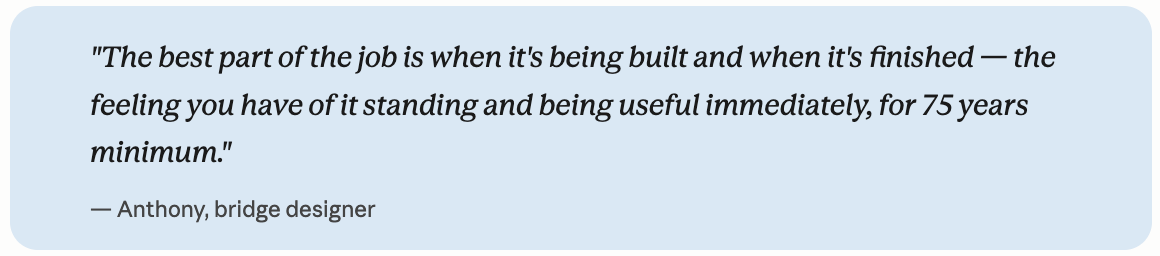
Most modern bridges are designed for approximately 75 years, though many remain in service for much longer when properly maintained and repaired.
What bridges are the hardest to design?
Long-span bridges over wide waterways are the engineering frontier. Anthony mentioned two that capture the imagination of every bridge engineer: a crossing at the Strait of Gibraltar connecting Spain and Morocco, and a Bering Strait crossing between Russia and Alaska. Both are technically feasible — the barriers, he says, are political and financial, not engineering.
This show was first published on March 2025