ICU Nurse's Career: A Job In High Demand
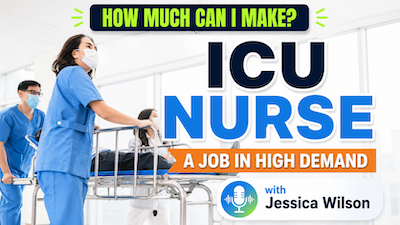
ICU & Labor and Delivery Nurse — What Nurses Really Earn
$30/hr → $90/hr+
Go behind the curtain with Jessica Wilson, a registered nurse with 20 years of experience splitting her time between the ICU and the labor & delivery floor. She shares real numbers, unforgettable patient stories, and honest advice for anyone considering a career in nursing.
What you'll learn in this episode:
How to become a registered nurse — the fastest and most flexible paths
What ICU and labor & delivery nurses actually do every shift
How much you can earn
How overtime, night differentials, and certifications boost your paycheck
What nursing specialties pay the most — including the one that tops them all
The challenges and reward of the job

How Much Can a Nurse Earn?
Nursing pay varies widely based on location, specialty, degree level, and whether you work for a hospital or as an independent travel nurse. Here's how the numbers break down:
LPN (18-month program)$20–$28/hr - $40K–$58K
RN — upstate New York~$30/hr - ~$62K
RN — NYC metro area~$59/hr - ~$122K
Travel nurseUp to $90/hr + housing - $150K–$180K+
Nurse practitioner $60–$90/hr - $125K–$185K
Nurse anesthetist (CRNA)$100–$130/hr+ - $200K–$250K+
On top of base pay, nurses can earn significantly more through overtime (time-and-a-half or double time during staffing shortages), night shift differentials ($5/hr extra in Jessica's case), holiday pay, and specialty certifications like Critical Care RN (CCRN).
QUICK ANSWER — HOW TO BECOME A NURSE
The fastest path is a 3-year associate's degree RN program at a community college, followed by passing the NCLEX licensing exam. A 4-year bachelor's degree (BSN) opens more doors and higher pay. From there, nurses can specialize in ICU, labor & delivery, emergency medicine, psychiatry, elder care, and more.
How Do You Become a Registered Nurse?
Associate's degree (ADN): ~3 years at a community college — the fastest route to becoming an RN
Bachelor's degree (BSN): 4 years — opens more specialty and leadership opportunities
NCLEX exam: Required after completing either program to obtain your RN license
Specialty training: Once hired, nurses pursue certifications in their chosen area (ICU, OB, psych, elder care, etc.)
Advanced degrees: Master's programs lead to nurse practitioner or nurse educator roles; CRNA programs require ICU experience first
What Does a Labor & Delivery Nurse Do?
Quick answer - Labor & delivery nurse role - A labor and delivery nurse admits and assesses patients, monitors fetal heart tones, helps manage the labor process, coordinates with OB physicians, midwives, and doulas, and responds to emergencies including infant resuscitation. No two shifts are the same — labor is unpredictable and moves fast.
Admit and assess patients arriving at the birthing center
Place patients on fetal monitors and track baby and maternal vitals throughout labor
Assist with comfort, positioning, and preparation for delivery
Coordinate with OB physicians, midwives, and doulas as part of the care team
Respond to emergencies — including infant resuscitation (a skill renewed every two years)
What Does an ICU Nurse Do?
Care for critically ill patients with severe infections (sepsis), strokes, respiratory failure, and gastrointestinal emergencies
Manage patients on ventilators and complex medication drips
Run resuscitation protocols ("coding" a patient) when cardiac or respiratory arrest occurs
Coordinate transfers to higher-level trauma centers when a community hospital's resources are exceeded
You may also like:
Operating Room Nurse, 40 years Career Insight →
Labor of Love - Birth Doula’s Career →
FAQ
How much does a registered nurse make per hour?
It depends on location and specialty. In the New York City metro area, experienced RNs earn around $59 per hour. In upstate New York, that drops to roughly $30. Travel nurses can earn up to $90 per hour, with housing and insurance included.
What is the highest-paying nursing specialty?
Nurse anesthetists (CRNAs) are the top earners in nursing, often making $100–$130+ per hour. They work alongside anesthesiologists and require prior ICU experience plus a specialized graduate program to qualify.
How much do travel nurses make?
Up to $90 per hour, plus employer-covered health insurance and a housing stipend. The trade-off is relocating for assignment periods, which typically last 13 weeks at a time.
Is there really a nursing shortage?
Yes — and it has persisted for over 20 years. The shortage creates strong job security, frequent overtime opportunities at time-and-a-half or double time, and the ability for new graduates to move directly into specialty nursing.
What are the best nursing specialties for work-life balance?
Many RNs work three 12-hour shifts per week, leaving four days off. Night shifts pay more (via differential) but are harder on your personal schedule. ICU and OB allow deeper patient relationships than high-volume ER or medical-surgical floors, where nurses spread themselves much thinner.
Do nurses get support for burnout and emotional stress?
Many hospitals offer chaplain services, social workers, and formal debriefing programs — sometimes called "Code Lavender" — after traumatic patient events. Nursing communities also provide peer support, since nurses often find that only colleagues truly understand the weight of what they witness.