
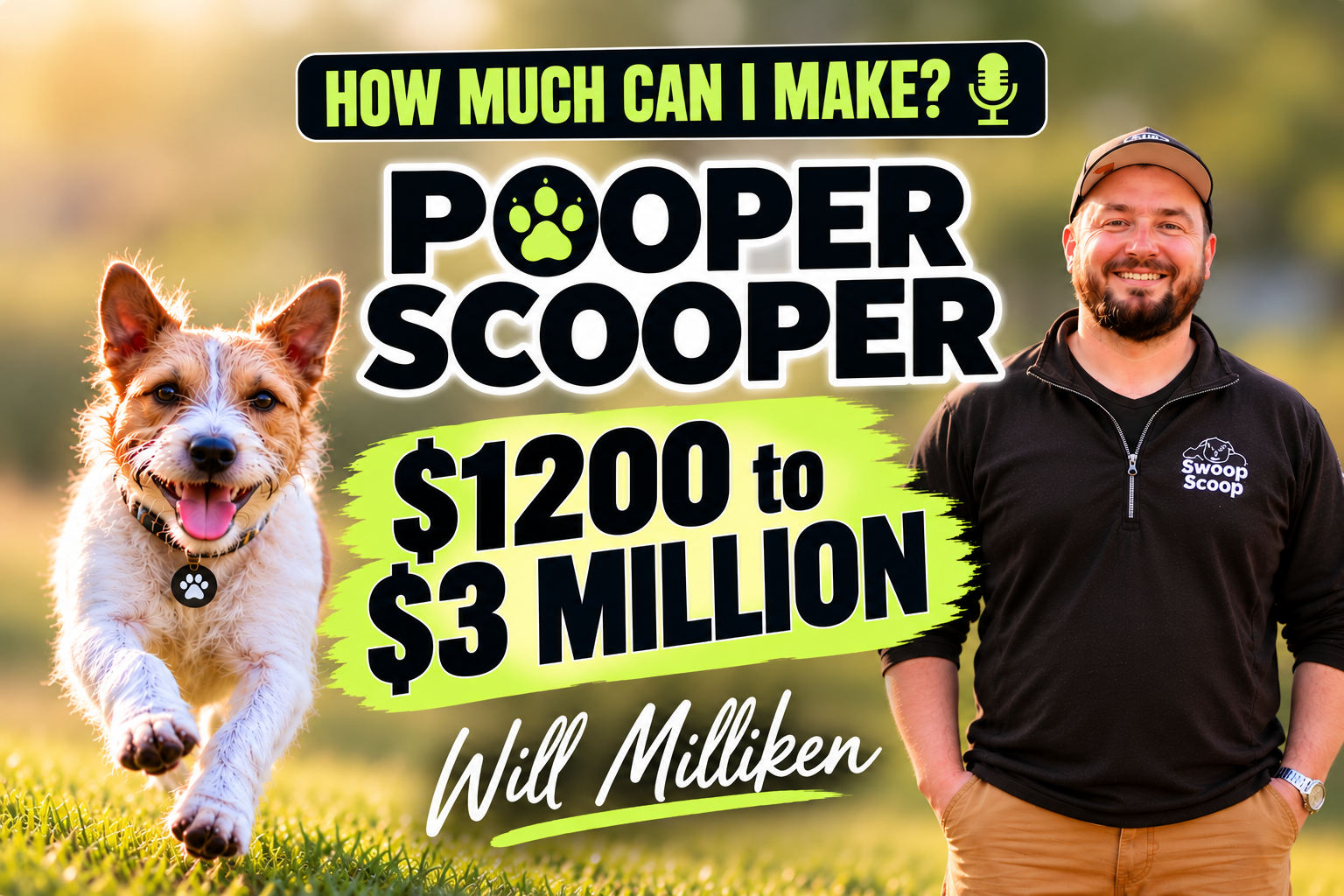
Pet Waste Removal Business: Salary, Startup Costs, and How Swoop Scoop Built a Multimillion-Dollar Company
$40K – $1+Mil
Mirav talks with Will Milliken about how grew from a basic pet waste pickup service into a multimillion-dollar business built on subscriptions, route density, and repeat customers.
What You’ll Learn in This Episode
- How pet waste removal businesses actually work
- What dog poop scooping services charge
- How much solo operators can make
- What affects profit the most in pet waste removal
- Why recurring clients make this business work
- How route density drives income
- What it takes to scale from side hustle to company
- How built a multimillion-dollar business
Pet Waste Removal Salary: How Much Can You Make?
Pet waste removal can start as a low-cost side hustle and scale into a highly profitable service business.
- Dog waste technician: $15–$25 per hour
- Solo pet waste removal operator: $40,000–$70,000
- Established owner-operator: $75,000–$120,000
- Pet waste removal business: $100,000–$300,000+ annual revenue
- Scaled company: $1M+ annual revenue
Profit depends on pricing, route density, labor costs, and how efficiently recurring customers are scheduled. The biggest advantage is simple: once a customer signs up, they usually need the service every week.
That recurring model is what turns a dirty job into predictable income.
Why Pet Waste Removal Still Pays
Pet waste removal works because it solves a recurring problem people do not want to deal with themselves. Dog owners need clean yards. Most do not want to do the work. That creates reliable demand. The business is simple to start, inexpensive to launch, and easy to understand. But the real money comes from recurring subscriptions, efficient routing, and stacking enough repeat customers into dense service areas. It is also difficult to automate. The work is physical, local, and highly dependent on consistency and trust.
For people looking for a low-barrier service business with recurring revenue and real growth potential, pet waste removal is one of the most overlooked opportunities in the market.
YOU MAY ALSO LIKE THESE EPISODES
Find out about more career in business & entrepreneurship →
Explore more entrepreneurship careers →
FAQ – Pet Waste Removal Business, Income & Growth
What is a pet waste removal business?
A service business that cleans up dog waste from residential yards or commercial properties on a recurring schedule (weekly, biweekly, or one-time cleanups).
How much does it cost to start?
Startup costs are relatively low—often under $1,000. Basic expenses include tools (scoopers, bags), transportation, branding, and simple marketing.
How does the business make money?
Most revenue comes from recurring subscriptions (weekly or biweekly service). This creates predictable, steady cash flow.
What do you charge customers?
Typical pricing ranges from $10 to $25 per visit per yard, depending on yard size, number of dogs, and frequency of service.
Is this business scalable?
Yes. Growth comes from adding routes, hiring workers, and increasing customer density in specific geographic areas to maximize efficiency.
What are the biggest expenses?
Labor, fuel/transportation, insurance, and marketing are the primary ongoing costs.
What skills do you need to succeed?
Reliability, basic customer service, route planning, and consistency. As you grow, management and hiring become critical.
How do you get your first customers?
Local marketing works best: flyers, door-to-door outreach, Google Business listings, neighborhood apps, and referrals.
Is there real demand for this service?
Yes. Busy pet owners, elderly homeowners, and multi-dog households often prefer outsourcing this task, creating steady demand.
What makes this a “recurring revenue” business?
Customers typically sign up for ongoing service rather than one-time jobs, creating predictable monthly income.
Can you run this business part-time?
Yes. Many start part-time and expand as they build a customer base.
What are the biggest challenges?
Weather conditions, physical work, customer retention, and maintaining consistent service quality.
What are the advantages of this business?
Low startup cost, steady demand, recurring revenue, and the ability to scale without needing advanced technical skills.
Can this turn into a full-scale company?
Yes. With strong systems, branding, and hiring, it can grow into a large local or multi-city operation.