Inside a NASA Contractor Job
Systems Engineer Salary & Artemis Missions
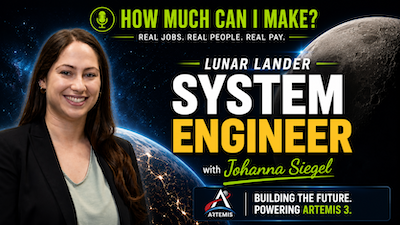
NASA Contractor Reveals the Systems Engineer Job: Salary, Artemis & What It Really Takes
$75K - $250K+
In this episode, we go behind the scenes with Johanna Siegel, a systems engineer working for KBR, a NASA contractor focused on astronaut health and comfort. She works primarily on Artemis III and the Lunar Lander, covering requirements for radiation protection, IVA suits, and waste management systems. She explains how engineers without aerospace backgrounds break into the space industry, what it actually takes to design for humans in space, and why delayed gratification comes with the territory.
What you'll learn in this episode:
What a systems engineer actually does every day
How Joanna went from bioengineering student to NASA contractor
The engineering challenges of sending humans back to the Moon
How engineers test equipment before it ever reaches space
What systems engineers earn at different career stages
Why collaboration is one of the most important engineering skills
How NASA technology improves life here on Earth
Why Artemis is preparing humanity for future missions to Mars

How much can you earn?
Pay depends on location, degree level, and whether you're on a government contract or working for a private company. Government contractors offer stability but typically lower salaries than private aerospace firms.
Entry level (bachelor's degree, no experience): ~$70K–$80K/year
Early career (2–4 years experience): ~$85K–$100K/year
Mid-level systems engineer (5–10 years): ~$100K–$130K/year
Senior / lead engineer: $130K–$160K+
Private industry (SpaceX, Blue Origin): significantly higher across all levels
Location factor: Houston salaries reflect a lower cost of living than major tech hubs. Private aerospace companies may pay more than government contractors, while government positions often offer greater stability and benefits.
You may also like:
Digital Imaging Technologist →
FAQ
What degree do you need to be a NASA systems engineer?
An engineering degree is typical, but it doesn't have to be aerospace. Joanna studied bioengineering at the University of Pittsburgh and came to NASA contracting through the medical device industry. What matters is foundational engineering knowledge and the ability to manage complex technical requirements across teams.
How do you get a job working for NASA without a NASA internship?
Joanna applied for NASA internships throughout college and never got one. Her path in was through industry co-ops, a job at a medical device company, and eventually applying to KBR — a NASA contractor — directly. Contractors like KBR, Jacobs, and others hire independently and are a major entry point into the space industry.
What's the difference between working for NASA directly vs. a NASA contractor?
NASA civil servants are government employees; contractors work for private companies that hold NASA contracts. Contractor pay is typically lower than private industry but offers access to NASA missions and facilities. The Human Health and Performance contract at Johnson Space Center, held by KBR, is one example.
How do you test space hardware on Earth?
Hardware that doesn't depend on gravity (electronics, software) is tested on the ground. For gravity-sensitive systems — like the waste management system — engineers can send hardware to the International Space Station, which is continuously crewed and set up for microgravity experimentation.
Is government contract pay lower than private aerospace?
Yes, significantly. Companies like SpaceX and Blue Origin have larger budgets and pay more at every level. Government contracts offer more stability and mission access, but engineers willing to move to private companies can expect meaningfully higher salaries.
What is the Artemis program?
Artemis is NASA's program to return humans to the moon — including the first woman and first person of color — before eventually sending humans to Mars. Artemis II will orbit the moon; Artemis III will be the first lunar landing of the program, with a planned surface stay of roughly six to seven days.
This show first aired in 2025; re-released April 2026 following the Artemis 2 launch.