
Social Worker Career: Salary, Burnout & Helping Families Through Crisis
$40K – $300K+
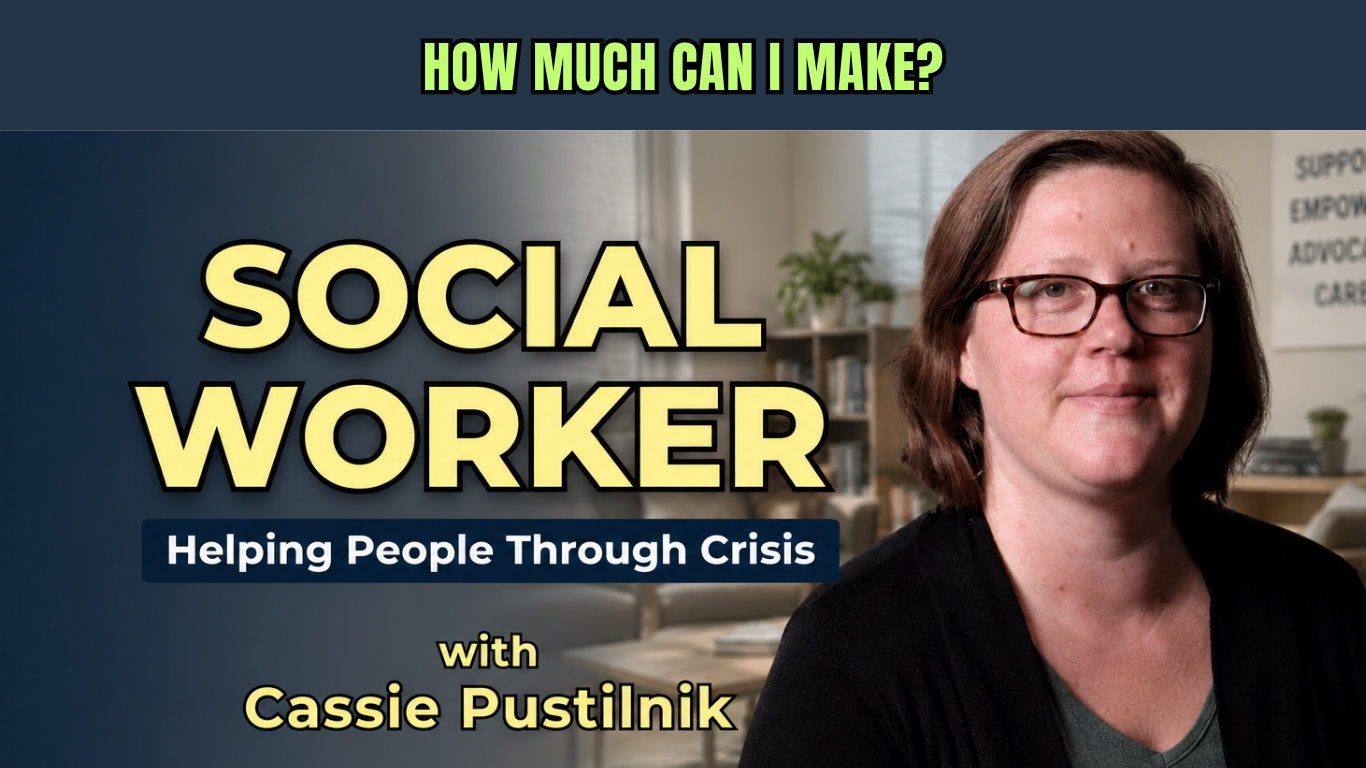
In this episode, we go behind the scenes with Cassie Pustilnik, Executive Director of Youth Research Inc. Youth Research Inc (YRI), who has spent nearly 20 years in human services in Philadelphia and New York. She explains what social workers actually do inside child welfare, hospitals, and schools, how much the job pays at every level, and how she rose from frontline caseworker to running a $20 million nonprofit.
What you’ll learn in this episode:
- How a frontline caseworker rose to executive director of a $20 million nonprofit
- What social workers actually do inside child welfare, hospitals, and schools
- How much social workers earn — from entry-level caseworker to executive director
- Why you don’t need a master’s degree to start working in social services
- How social workers cope with vicarious trauma and compassion fatigue
- How racial bias shows up in child welfare — and what “blind removals” means

How much can you earn?
Social work pay is tiered by degree level, role, and whether you’re doing direct clinical work or running an organization. A bachelor’s-level caseworker and a nonprofit executive director are both “social workers” — but their pay can differ by a factor of six.
Entry level (bachelor’s/BSW, no experience): $40K–$45K
Entry level (master’s/MSW): ~$60K
Case management supervisor: $80K–$90K
Program director: $85K–$90K
Licensed psychotherapist (25–30 client caseload): low six figures
VP / senior management (at a $10M–$15M organization): $130K–$150K
Executive director (large nonprofit or state-affiliated agency): $200K–$300K+
You may also like:
Physical Therapist Career Insights: A Journey to Improve Lives
OR Nurse- a Job in high demand
Explore More health & Wellness Careers
FAQ
How much do social workers make?
Entry-level social workers with a bachelor’s degree typically start around $40,000–$45,000, while those entering with a master’s degree (MSW) start closer to $60,000. Supervisors and program directors earn $80,000–$90,000, licensed psychotherapists with a full caseload can reach low six figures, and executive directors of large nonprofits or state-affiliated agencies can earn $200,000–$300,000 or more.
Do you need a master’s degree to become a social worker?
No. You can work in social services with a bachelor’s degree — as a caseworker, in early childhood education programs, in a childcare setting, or in hospital case management. A master’s degree (MSW) is generally required to do direct clinical work, such as acting as a patient’s therapist, or to advance into higher-level supervisory and leadership roles. Some states, including Pennsylvania, offer programs that pay for an MSW in exchange for a commitment to work for a state human services department afterward.
What does a caseworker actually do?
A caseworker manages a family’s case plan — checking whether they have safe housing, whether kids are in school and seeing a doctor, and connecting families to resources like job training, parenting classes, or public benefits. Visit frequency depends on how serious the case is classified, ranging from weekly to several times a week. New caseworkers complete a minimum of six weeks of full-time training before working with families independently.
What is vicarious trauma, and how do social workers avoid burnout?
Vicarious trauma is when a social worker begins to internalize and experience the trauma of the people they’re helping. It’s closely linked to compassion fatigue and burnout, which are common in the field. Social workers manage it by setting firm boundaries around work hours, practicing deliberate self-care, and choosing an organization or specialization whose mission genuinely sustains them over time.
What is a “blind removal” in child welfare?
A blind removal is a policy — used in states including New York — where decision-makers evaluate whether a child should be removed from their family’s custody without seeing the family’s race or ethnicity. It’s designed to reduce racial bias in child welfare decisions, since Black and brown families have historically faced higher removal rates than white families with comparable complaints.
What degree do you need to become a social worker?
A bachelor’s degree in social work (BSW) is enough for many entry-level roles. A master’s degree (MSW) opens up clinical work and most supervisory or leadership positions, and a doctorate (DSW) is typically pursued by those who want to teach or run a human services agency at the highest level.
This show first aired in 2025