Imaging Technologist - Behind the Scan
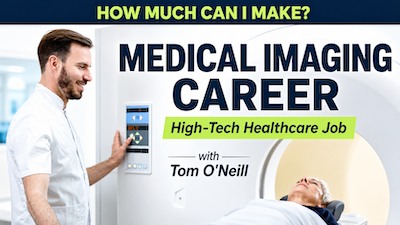
Medical Imaging Technologist Career: Salary, CT Scans, MRI & Is It a Good Career?
$60K – $120K+
What you'll learn in this episode:
How to become a medical imaging technologist
The difference between CT, MRI, and X-ray careers
What imaging technologists really do every day
How much CT and MRI technologists can earn
Why travel imaging jobs often pay the highest salaries
Why a tech can never tell you what they see on your scan — even if they know
How AI is changing medical imaging—but hasn't replaced technologists
The emotional challenges of working with seriously ill patients
Why communication skills matter just as much as technical knowledge

How much can you earn?
Medical imaging salaries vary by specialty, experience, certifications, shift differentials, and location.
Entry-level Imaging Technologist: $60,000–$75,000
Experienced CT/MRI Technologist: $85,000–$120,000+
Travel Imaging Technologist: $120,000–$170,000+ (including tax-advantaged travel stipends)
Technologists can increase their income through:
CT certification
MRI certification
Evening and overnight differentials
Weekend and holiday pay
Overtime
Travel assignments
You may also like:
Behind operating Room Doors: 40 Years OR Nurse Career →
FAQ
How much does an imaging technologist make?
Entry-level techs typically start at $28–$32/hr. With experience and modality certifications (CT, MRI), pay ranges from $40–$50/hr. Travel positions can reach $3,000/week when non-taxable stipends for housing and food are factored in.
What schooling do you need to become an imaging technologist?
Most techs complete a two-year X-ray technology program. From there, additional modality training — CT, MRI, interventional radiology — happens on the job and through certification exams administered by the American Registry of Radiologic Technologists (ARRT).
What does an imaging technologist do?
They operate diagnostic imaging equipment (X-ray, CT, MRI), position patients for scans, perform daily quality assurance on the machines, and ensure every image meets the radiologist's reading standard. They do not interpret or diagnose.
Can an imaging technologist tell you what they see on your scan?
No. Interpreting images is the radiologist's role. A tech may recognize patterns from experience, but diagnosis requires physician-level training and legal authority. Sharing findings with a patient — even informally — is professionally prohibited.
Is imaging technology a growing field?
Yes. Demand is strong, and the travel tech market is especially active right now. Many experienced techs are choosing travel contracts over full-time positions because the total compensation — including non-taxable stipends — is significantly higher.
Do imaging technologists need a license?
Yes. Most states require a state license, and techs must maintain national certification through the ARRT with continuing education every two years. New York, Florida, and California have the most rigorous licensing requirements.
What's the difference between a CT scan and an MRI?
CT uses X-rays and computer reconstruction to produce cross-sectional images and 3D models. MRI uses magnetic fields and radio waves and can image in any plane. Both produce grayscale images. CT is faster and better for many acute conditions; MRI offers more detail for soft tissue.
This show first aired in April 2025