Independent Pharmacist Reveals the Truth About Pharmacy Careers, Ownership & Earnings
$60/hr – $80/hr
Staff pharmacist salary range. National median is approximately $137,000–$140,000/year. Independent pharmacy owner income varies widely — and may include losses on individual prescription claims.
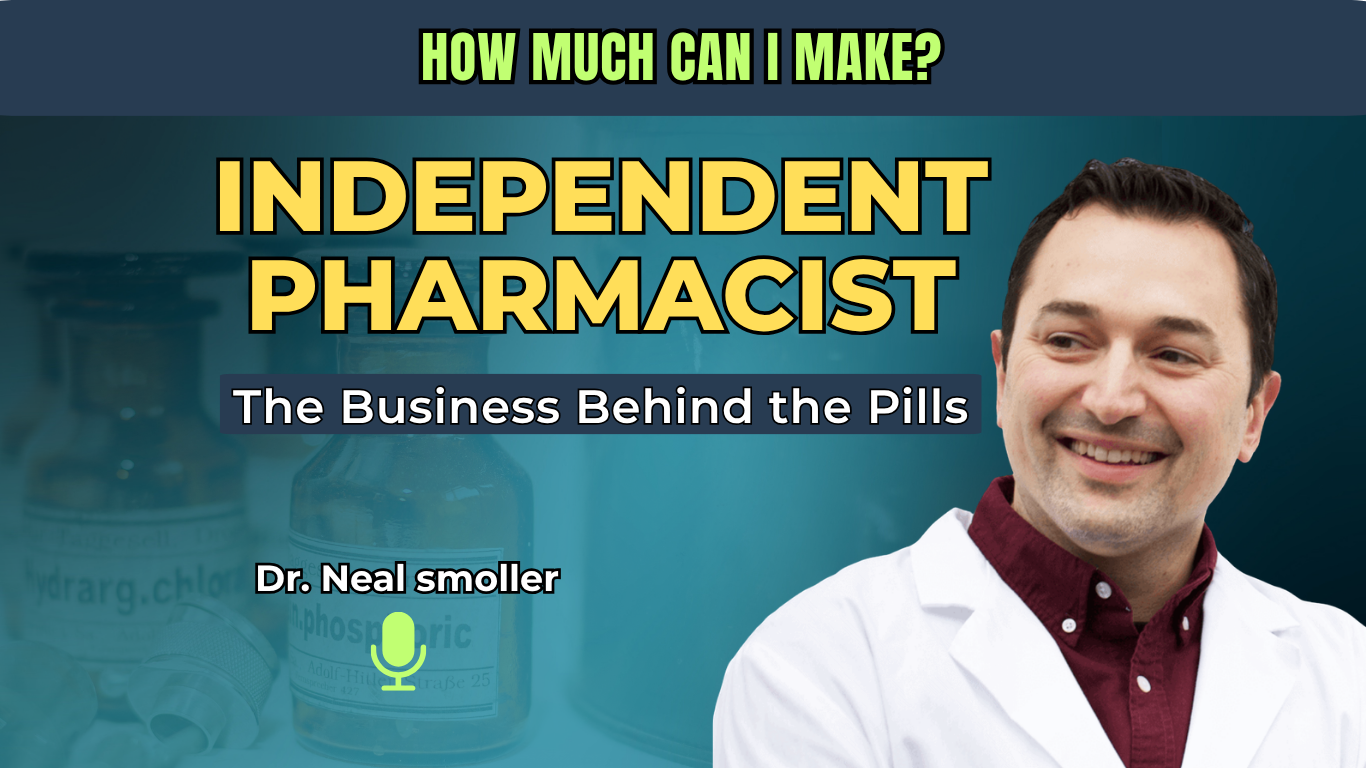
Think pharmacists are rolling in it? Think again. Dr. Neal Smoller has been a pharmacist for over 20 years and owns Village Apothecary in Woodstock, New York. In this episode, he breaks down exactly what pharmacists earn, why independent pharmacies are disappearing, and the rigged system that’s making it nearly impossible to stay in business. Spoiler: filling a prescription can actually cost you money.
What you’ll learn in this episode:
- How much pharmacists actually make per hour — and what’s changed since graduation used to mean financial freedom
- Why filling a prescription can cost an independent pharmacy money (yes, really)
- What PBMs are and how they’ve rigged the entire system against independent pharmacies
- Why Dr. Smoller chose to keep his smaller Woodstock store over a location doing 3–4x the volume
- How giving 70,000 COVID vaccines out of a 1,400 sq ft store briefly made the business math work
- What it actually takes to open and run your own pharmacy
- Whether pharmacy school is still worth it in 2025 — and what Dr. Smoller honestly thinks
How much can you earn?
Pharmacy remains one of the higher-paying healthcare careers, although student debt and industry changes have altered the financial picture.
- Entry-level Pharmacist: $125K–$145K
- Experienced Pharmacist: $145K–$180K+
- Pharmacy Manager: $160K–$220K+
- Independent Pharmacy Owner: $150K–$250K+ (highly dependent on business performance)
For independent pharmacy owners, the picture gets more complicated. The prescription business alone, in many markets, breaks even at best. The real money — when there is any — comes from diversification: supplements, specialty products, vaccine administration, and clinical services. Dr. Smoller’s store survived partly because the supplement business was strong enough to make the pharmacy less dependent on prescription reimbursements.
What does a pharmacist actually do?
Most people picture a pharmacist counting pills behind a counter. The reality is far more complex — especially for an independent pharmacy owner. Dr. Neil Smoller has always practiced pharmacy the way he imagined it at age 14: as a community figure, a trusted resource, someone people look up to. He designs dietary protocols for patients with terminal diagnoses. He counsels people on supplements, sleep, mental well-being, and how everything interacts with their prescriptions. He manages inventory across hundreds of drug SKUs, each with multiple manufacturers and different reimbursement rates. And he does all of that while trying to keep his business financially alive in one of the most hostile reimbursement environments in the country.
For staff pharmacists, the day-to-day is more focused: verifying and dispensing prescriptions, consulting with patients on medications and interactions, supervising pharmacy technicians, and managing insurance claim adjudication. A pharmacist today holds a doctorate degree — six years of school — and is one of the most accessible healthcare providers in the country. People walk in without appointments and get real clinical advice. That’s the part of the job that doesn’t show up in the salary number.
You may also like:
FAQ
How much does a pharmacist make per hour?
In the New York market, pharmacists typically earn between $60 and $80 per hour. Nationally, the median pharmacist salary is around $137,000–$140,000/year as of 2025 — roughly $65–$70/hr. When Dr. Smoller started 20 years ago, the New York range was $50–$70/hr. The rate has grown modestly, but student loan debt — now often $240,000 or more — has significantly reduced the financial upside compared to earlier generations.
What state pays pharmacists the most?
California leads on raw salary, with pharmacists averaging around $162,000/year — though high cost of living cuts into the real-dollar value. After adjusting for cost of living, Minnesota consistently ranks as the best state for pharmacist pay. New York and Washington, DC are also among the top markets. At the lower end, states like Arkansas, Kentucky, and Missouri tend to average closer to $90,000–$100,000/year.
How much does a pharmacy owner make?
It varies dramatically and depends heavily on the pharmacy’s revenue mix. Independent pharmacy owners who rely primarily on prescription reimbursements often struggle to break even. Those who’ve diversified into supplements, vaccines, and clinical services have more stable income. The prescription business alone, in many markets, is not reliably profitable.
Why are independent pharmacies closing?
The primary driver is pharmacy benefits managers (PBMs) — the middlemen between insurance companies and pharmacies. The largest PBMs are owned by chain pharmacies, which allows them to set reimbursement rates that favor their own stores. Independent pharmacies are frequently paid less than the cost of the drugs they dispense. This structural disadvantage has been driving closures since around 2016.
What is a PBM and why does it matter for pharmacists?
A pharmacy benefits manager (PBM) is the intermediary between an insurance company and a pharmacy. They determine which pharmacies patients can use, what drugs are covered, and how much each pharmacy gets paid. When a chain pharmacy owns the PBM — as CVS owns Caremark — they can set rules that direct patients and profits toward their own stores, leaving independent pharmacies at a structural disadvantage.
How many years of school does it take to become a pharmacist?
Six years, resulting in a Doctor of Pharmacy (Pharm.D.) degree. Some paths include a two-year pre-pharmacy undergraduate program followed by four years of pharmacy school, or a direct six-year program.
Is being a pharmacist still a good career?
For people who are genuinely passionate about patient care and clinical practice, yes. The hourly rate is strong, the work is meaningful, and pharmacists are among the most accessible healthcare providers people can see without an appointment. The caveat is debt: with $240,000 or more in student loans for many graduates, the financial freedom that earlier generations of pharmacists took for granted is much harder to achieve today.
What do pharmacists do besides fill prescriptions?
Quite a lot. Pharmacists consult patients on drug interactions, advise on supplements and wellness, administer vaccines, design care plans, manage inventory, handle insurance billing, and — in independent pharmacies — often serve as a primary point of contact for patients navigating complex health situations. Dr. Smoller has designed dietary protocols for patients with terminal diagnoses and counseled patients on everything from sleep to mental health to managing chronic conditions holistically.
Can a pharmacy lose money filling a prescription?
Yes. According to Dr. Smoller, about 17% of the time, independent pharmacies are reimbursed less than the cost of the drug itself — up from under 1% when he started 20 years ago. For expensive brand-name medications, losses of $20–$100 per claim are common. During the early GLP-1 boom, pharmacies were losing $80–$100 on every weight loss drug prescription they filled.
This episode features Dr. Neil Smoller, holistic pharmacist and owner of Village Apothecary in Woodstock, New York.