How Much Do Professors Make? Salary, Tenure & Reality
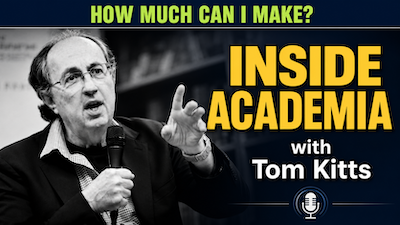
English Professor Reveals the Real Salary, the Tenure Game & What It Takes to Write About Rock Legends
$90K – $160K+
What is it like to build a career teaching English at the college level—and how much can you make doing it? In this episode English professor Dr. Tom Kitts at St. John’s University shares a behind-the-scenes look at academic life, from adjunct teaching to tenure-track roles. We break down salary ranges, job stability, and the real path into higher education, including graduate degrees, publishing, students using AI and the realities of today’s academic job market. Including his books about Rock 'n Roll legends like Ray Davies, John Fogerty, and Richie Furay.
What you'll learn in this episode:
How to become a college professor
What professors actually do beyond teaching
Why publishing is critical for tenure
How much professors can earn
What English majors can do outside academia
How AI is changing higher education
The realities of writing books and earning royalties
The rewards and challenges of a life in academia

How much can an English professor earn?
Here's how the earning tiers break down based on Tom's experience and the broader academic landscape:
Entry-level (new PhD, no tenure): $80K–$95K in English and humanities fields. The job market for these positions is tight and competitive.
Associate professor (post-tenure, 7–10 years in): $100K–$130K at many research universities, with annual merit increases building over time. Tenure is the turning point — once you have it, you have financial stability and significant freedom over how you spend your time.
Full professor (Tom's level, 20+ years): $130K–$160K+ depending on the institution, discipline, and any administrative roles. Tom describes his salary as "very good" and says it allows him to pursue the writing and research projects he cares about without financial pressure.
Professors also may earn additional income from:
Books and royalties
Speaking engagements
Consulting
Research grants
Academic editing and publishing
You may also like:
Teacher’s Job - Teaching in a Red State→
Become a consultant - Turn Your Skills to $$$$→
Economy Journalist - Careers Money & Economy →
What does a professor actually do?
Many people assume professors simply teach a few classes each week. The reality is much more complex. A professor's responsibilities often include:
Teaching undergraduate and graduate courses
Advising students
Conducting research
Publishing articles and books
Presenting at conferences
Serving on university committees
Mentoring junior faculty
Reviewing academic work for journals
For tenure-track professors, publishing research is often as important as classroom performance.
Publish or Perish
One of the biggest surprises for people considering academia is how important publishing becomes. According to Tom, earning tenure generally requires success in three areas:
Teaching
Service to the university
Research and publication
The third category is often the most difficult. Young professors must publish in peer-reviewed journals, attend conferences, network with scholars, and contribute original research to their field. Without publications, tenure can be difficult—or impossible—to achieve.
Is an English Degree Still Useful?
One of the most interesting parts of the conversation centers on the value of an English degree. Tom argues that English majors develop skills employers consistently seek:
Writing
Communication
Critical thinking
Analysis
Research
These skills can lead to careers in:
Publishing
Law
Marketing
Business
Journalism
Public Relations
Education
Government
Academia in the Age of AI
Artificial intelligence is creating new challenges in higher education. Professors increasingly face AI-generated essays and assignments that are difficult to detect.
Tom discusses how universities are adapting and why authentic writing and critical thinking remain essential skills despite advances in AI technology. The conversation raises important questions about the future of education and how students can use AI responsibly without replacing genuine learning.
The Rewards of Teaching
Despite the challenges, Tom says the greatest reward comes from seeing former students succeed. Whether they become lawyers, business leaders, writers, or educators, helping students develop confidence and critical thinking skills remains the most meaningful part of the job.
For many professors, those long-term relationships are worth more than any publication or promotion.
FAQ
How much does an English professor make?
At a major university, a new English PhD can expect to start around $90,000. Tenured associate and full professors typically earn $100,000–$160,000+, with salary growing through annual merit increases over the course of a career.
Do you need a PhD to become a professor?
In most university disciplines, a PhD is required for full-time professorships. Some professional fields may hire faculty based on industry experience and master's degrees.
What is tenure?
Tenure provides long-term job security to professors who demonstrate excellence in teaching, research, and service to their institution.
How much do academic authors make from book royalties?
Very little. Royalty rates on academic books are typically around seven percent, and sales are modest. Most academic authors earn a few thousand dollars per book, total. The financial value of publishing is in tenure and reputation, not income.
What can you do with an English degree besides teach?
Quite a lot. Tom points out that law schools actively recruit English majors for their writing and critical thinking skills. His own brother, a history major with similar transferable skills, retired as a senior VP at the Bank of New York. English and humanities graduates end up in law, finance, publishing, marketing, communications, and beyond.
Is being a professor a good career financially?
It depends on the discipline and institution. In humanities, starting salaries are lower than STEM fields, and the path to tenure is long and competitive. But tenured full professors at major universities earn solid six-figure salaries with strong job security, excellent time flexibility, and the freedom to pursue research and writing alongside teaching.
This show first aired on September 2025